


|

|
This is a limited free preview of this book. Please buy full access.
Observers have noted a “distanced,” objective quality in Kang-baek Lee's dramas, one that sets his work apart from plays that have a cause-effect, climactic moment, followed by a resolution of the opposing forces. To the Western reader of the plays in this important anthology, Mr. Lee may seem more interested in the struggle of opposing ideas than in the dramatization of a character's emotional journey. There is no question that he values the opposition of ideas in the theatre. Aristotle placed plot first in importance in drama, followed by character and thought. Kang-baek Lee's works seem to reverse that order.
Mr. Lee is a brilliant word craftsman but, unlike some of his contemporaries who came to playwriting via literary studies, he is also a man of the theatre. Mr. Lee's visual language is both extraordinary in its range and impressive in its theatricality: people as works of art hanging on a wall in Chaos and Order at a Gallery (1975); the personification of a child's spirit before the child is born and the use of living dancers as bodhisattva statues in Feeling, Like Nirvana (1998); a stream of sand pouring down in a stream of light in Cold Sweat (2002); and the battle of personified good and evil spirits in his musical for children, The Love of Grandma Stork (2002).
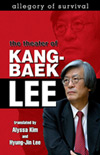
Kang-baek Lee played—and continues to play—a formative role in the maturation of South Korean theatre, but Western appreciation for his accomplishments has been limited largely to European theatre centers. Ah-jeong Kim's seminal 1999 book, The Metacultural Theatre of Oh T'ae-S k: Five Plays from the Korean Avant-Garde is a signal contribution to contemporary, English-language studies of Korean theatre. The present anthology by Alyssa Kim and Hyung-jin Lee introduces to an English-reading audience a playwright whose passion for truth could not be staunched by decades of censorship and whose imagination lit the way for many younger playwrights now at the forefront of South Korean theatre.
When I first met Kang-baek Lee, I was fortunate enough to accompany him backstage after a performance of another play-